
Review · WALKING TOURS
Antigua Walking Tour Morning and Afternoon
Antigua rewards slow looking. This 3.5-hour walk gives you a useful first map of the city, linking the Central Plaza, colonial churches, museums, and artisan markets in one compact route. I like the strong mix of architecture and local history, and I also like that guides such as Armando and Moises have earned praise for their clear English and personal connection to Antigua. The main drawback is that entrance fees, drinks, and snacks are not included, so the final cost can rise if you enter several sites.
I also like the small group limit of 15 people, which should make it easier to hear the guide on busy streets. The tour ends at the Mercado de Artesanias, a practical finish if you want to shop. Still, this is a walking tour, not a full museum program, and some stops receive only a short visit.
In This Review
- Key points at a glance
- Why this 3.5-hour walk works as an Antigua introduction
- The Plaza Mayor and Antigua’s careful grid
- San José Cathedral and the city’s earthquake story
- Museo de Arte Colonial and the old university
- San Francisco el Grande and Pedro de San José de Betancur
- Concepción Convent and the city’s literary past
- Casa Santo Domingo’s convent rooms and museums
- The Carmen facade and Mercado de Artesanias
- What the guides add to the walk
- Cost, timing, and practical planning
- Who should book this Antigua walk?
- Should you book the Antigua Walking Tour?
- FAQ
- How long does the Antigua Walking Tour last?
- What is the price of the tour?
- Where does the tour begin?
- Where does the tour end?
- Are entrance tickets included?
- How many people can join the tour?
Key points at a glance
- The Plaza Mayor explains Antigua’s street plan: Learn how the city was organized around a central square in 1541.
- The route covers major religious landmarks: San José Cathedral and San Francisco el Grande show how earthquakes shaped Antigua.
- Casa Santo Domingo adds museum time: A former Dominican convent now combines preserved colonial architecture with museum displays.
- The guide can make the difference: Armando and Moises received especially warm praise for their charm, English, and local knowledge.
- The ending is useful for shoppers: You finish at the Mercado de Artesanias, two blocks from the Central Plaza.
- Budget for admissions: The $27 price covers the guide, but bottled water, coffee, tea, and entrance tickets cost extra.
Why this 3.5-hour walk works as an Antigua introduction
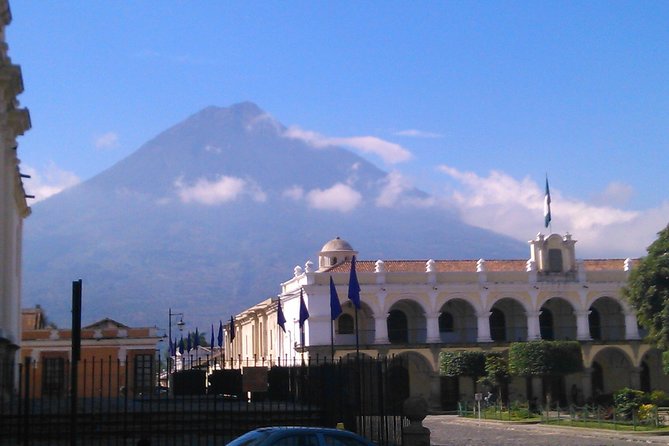
Antigua is easy to admire and surprisingly easy to misunderstand. Its cobbled streets, colorful facades, church ruins, and volcano views can blur together after a few hours. A guided walk gives those pieces an order.
This route begins at Café Condesa, at La Casa del Conde on 5a Avenida Norte, and moves through the historic center before finishing at the Mercado de Artesanias. That arrangement matters. You begin with the city’s grand civic heart, then see religious buildings, former convents, and finally a place where you can browse local crafts at your own pace.
At $27 per person, the tour is priced as an orientation walk rather than an all-inclusive sightseeing package. You are paying mainly for the guide’s explanations and route planning. Since admissions are extra, the value depends on how much you want context while walking and how many interiors you choose to enter.
The group can include up to 15 people. That is not a private tour, but it is small enough to feel more manageable than a large street group. The experience is offered in the morning and afternoon, giving you a useful choice: take it early to get your bearings before exploring alone, or use it later to fill part of your day.
More Walking Tours in Antigua Guatemala
- Antigua Cultural Walking Tour
★ 4.5 · 725 reviews - Antigua Guatemala: City Highlights Guided Walking Tour
★ 5.0 · 462 reviews - Antigua Classic Cultural Walking City Tour – the best
★ 4.5 · 227 reviews
The Plaza Mayor and Antigua’s careful grid
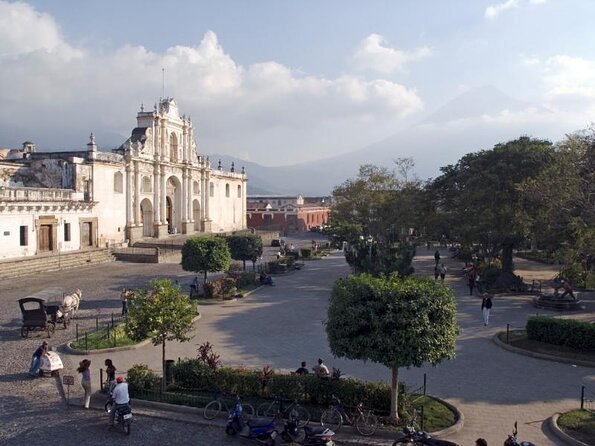
The Plaza Central Park is the right place to begin because the entire old city was planned from here. In 1541, engineer Don Juan Bautista Antonelli used a measured, reticulated design, with streets and blocks laid out in straight lines around a central square.
The dimensions are remarkably precise. The plaza measures about 112 meters from north to south and 115 meters from east to west. Its four sides were assigned to the city’s key institutions, including the town hall, cathedral, royal palace, and commercial arcades.
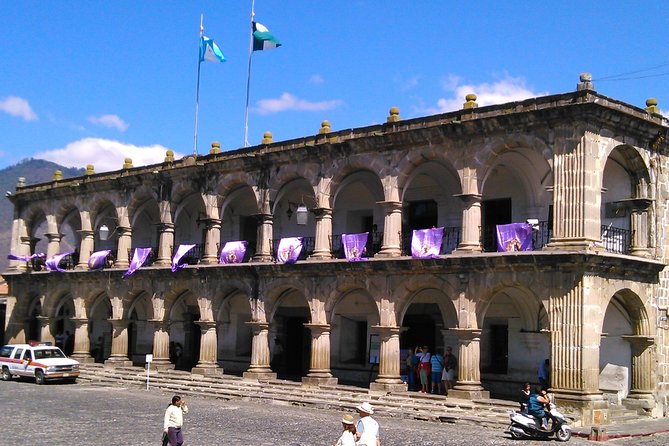
Your guide can point out the Portal of Chains and the Palace of the Noble City Hall on the north side. The Episcopal Palace and Cathedral of Santiago occupy the east. The Royal Palace faces south, while the Merchants Portal, also called Panaderas, is on the west.
In the middle is the Fuente de las Sirenas, or Fountain of the Sirens, built in 1739 by Diego de Porres. Five Esquisúchil trees, planted around 1994, now soften the formal square.
The scheduled visit here is about 20 minutes. That is enough to understand the layout and identify the main buildings, but not enough for a detailed architectural lecture on every facade. I would use this stop to listen closely to the city plan, then return later if you want photographs or quiet time on a bench.
San José Cathedral and the city’s earthquake story
The Catedral de San José occupies part of the former Cathedral of Santiago de los Caballeros. Its story is tied to repeated earthquakes, a theme that appears again and again across Antigua.
Construction on the first cathedral began in 1545, using materials brought from the settlement in the Almolonga valley. Earthquakes repeatedly slowed the work. The first building was demolished in 1669, and a second sanctuary opened in 1680 under Juan Pascual and José de Porres, with evidence that Martín de Andújar Cantos also worked on the reconstruction.
The church you see today is therefore not a single untouched colonial building. It is part of a long cycle of construction, damage, repair, and adaptation. That makes the stop more meaningful than a quick photograph of a church facade.
The tour allows about 20 minutes here, and admission is not included. That short period works well for an exterior explanation or a brief look inside, depending on opening conditions and any ticket requirement. If cathedral interiors are important to you, ask the guide how much time is available before paying an entrance fee.
Museo de Arte Colonial and the old university
The Museo de Arte Colonial stop connects Antigua with the University of San Carlos of Guatemala, known as USAC. Founded in 1676, it is the oldest and largest university in Guatemala and the fourth university founded in the Americas.
The institution began as the Royal and Pontifical University of San Carlos Borromeo. It remained Guatemala’s only university until 1954, passing through changes after independence in 1821.
Only five minutes are allotted here. That is the clearest sign that this part of the walk is an orientation stop, not a museum visit. You may hear why the building matters and how education worked during the Spanish colonial period, but you should not expect time to study a large collection.
Admission is not included. I would only pay to enter if you have a strong interest in colonial art or university history and can return for a longer visit. Otherwise, take the explanation as part of the larger story of Antigua’s civic and religious institutions.
More things to do in Antigua Guatemala:
- From Antigua: Adventure, 2-Day Hiking to Acatenango Volcano
★ 4.4 · 1,189 reviews - From Antigua: Pacaya Volcano Tour in English/Spanish
★ 4.5 · 930 reviews - From Antigua: Pacaya Volcano Trek
★ 4.4 · 798 reviews - Antigua, Guatemala: Volcano Acatenango Overnight Hiking
★ 4.6 · 645 reviews
San Francisco el Grande and Pedro de San José de Betancur
The Sanctuary of San Francisco el Grande brings together faith, reconstruction, and one of Antigua’s best-known religious figures. The first sanctuary was built in the mid-sixteenth century, then damaged by an earthquake in 1565. The current church was built in 1702 by Diego de Porres.
That building did not escape Antigua’s earthquakes. It suffered damage in 1717, 1751, and 1773, then remained abandoned for a time. Later earthquakes in 1874 and 1917 caused further harm. Reconstruction took place during the second half of the twentieth century, after the Guatemalan state again allowed regular religious orders to own property in the country. Franciscans returned to the complex in 1967.
The church is especially important because it contains the tomb of Pedro de San José de Betancur, a Spanish missionary who worked in Guatemala and became a saint. His presence gives the stop a human focus amid all the dates and structural damage.
The visit lasts about 20 minutes, with admission extra. This is one of the places where a good guide can make a real difference. Moises, who grew up in Antigua, was praised for making the city’s past easy to understand and for his personable manner. Armando was also praised for his charm and command of the subject. If your guide has a similar local connection, listen for details about how these buildings fit into present-day Antigua, not only what happened centuries ago.
Concepción Convent and the city’s literary past
The Concepción Convent appears as an additional point along the route. It is a ruined complex beside the Pensativo River and another reminder of the destruction that shaped Antigua.
The site also connects with Sister Juana de Maldonado, a poet and one of the city’s more debated historical figures. She professed as an urban nun at the convent during the first half of the seventeenth century.
The information available for this stop does not specify a visit length or admission arrangement. Treat it as a possible exterior or passing stop rather than building your day around entering the ruins. If this location matters to you, ask at the start how it fits into the walking sequence.
Casa Santo Domingo’s convent rooms and museums
Casa Santo Domingo is one of the strongest stops for seeing how Antigua’s religious past has been preserved for modern use. The site occupies the former Convent of Santo Domingo, once one of the largest convents in the Americas.
Today it functions as a five-star hotel and museum. Its colonial baroque architecture remains part of the experience, while museum displays present objects and artwork from the colonial period. The property opened in June 1989 and sits about a ten-minute walk from the Central Plaza.
This stop receives 30 minutes, the longest scheduled visit on the route. That extra time makes sense because the complex is larger and more layered than a single church facade. You can look at the stonework, courtyards, religious art, and surviving architectural details without treating the site as just another photo stop.
Admission is not included. You should also remember that this is an operating hotel as well as a museum. The tour gives you an introduction, but anyone interested in the collection may want to return independently for more time.
The Carmen facade and Mercado de Artesanias
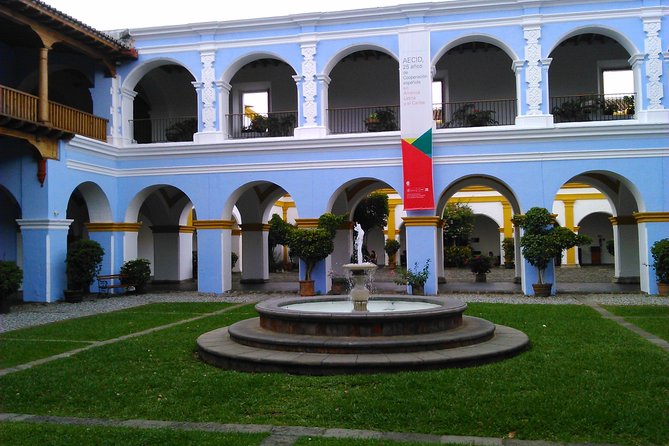
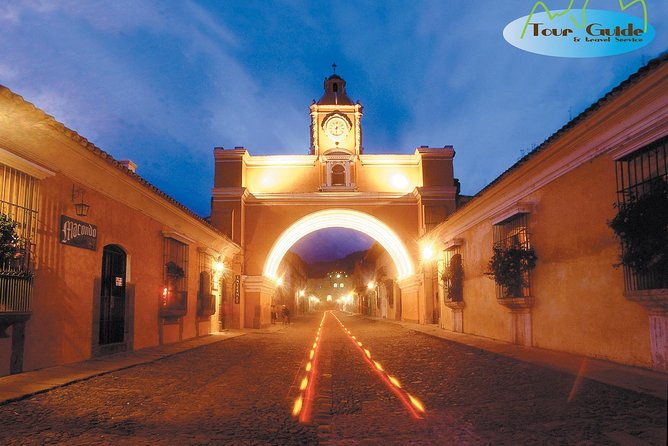
The final stop is listed as Mercado de Artesanias, but it also brings you to the remains of the Iglesia de Nuestra Señora del Carmen. The church was a grand Catholic building in Santiago de los Caballeros de Guatemala before the Santa Marta earthquakes destroyed it in 1773.
Most of the church was lost, but the facade survived in good condition. It is admired as an example of Guatemalan seismic baroque, a style shaped by the need to build in an earthquake-prone region. The Carmelite nuns later moved to Guatemala City, but the name Iglesia del Carmen remained.
The stop lasts about 30 minutes and admission is free. It is a fitting end because you can move from architecture to shopping without needing another transfer. The market is two blocks from the Central Plaza, so you are still in a convenient part of the old city when the tour ends.
You can shop on your own after the guided portion. That flexibility is useful if you want woven goods, small gifts, or time to compare prices. Since the tour does not promise a dedicated shopping lesson, ask your guide for practical suggestions if you want help understanding the stalls.
What the guides add to the walk
The strongest praise for this experience centers on the guides. Armando was described as charming and highly informed about the city’s architecture and past. Moises, also called Moses in one account, was praised for growing up in Antigua, speaking good English, and giving a clear overview of the city.
Those details matter because Antigua’s buildings often look impressive before you know what you are seeing. A local guide can explain why a facade survived, why a church was rebuilt several times, or how the city’s grid relates to the buildings around the Plaza Mayor.
One especially unusual moment came when Moises took a participant to a wedding during the walk. That is not a guaranteed part of the itinerary, and you should not expect it, but it shows how a local guide may connect the formal sightseeing route with ordinary life in Antigua.
The experience has a 5 rating from 39 reviews, with 100 percent of respondents recommending it. That is a strong record, though guide quality can naturally vary by departure.
Cost, timing, and practical planning
The $27 price is reasonable for a 3.5-hour guided walk in a historic city, especially if you want a city overview on your first day. It becomes less of a bargain if you plan to pay admission at every site and prefer to spend long periods inside museums.
The tour includes only the guide. Bring your own bottled water, since water, coffee, and tea are not provided. Wear shoes suited to cobbled streets and allow time for the route between stops, since the listed stop times add up to less than the full tour duration.
You receive confirmation when booking. Service animals are allowed, public transportation is nearby, and most people can participate. The tour requires good weather and a minimum number of participants. If weather or low enrollment cancels it, you can choose another date or receive a full refund.
Free cancellation is available until 24 hours before the start time. Cancellations or changes made inside that window are not refunded or accepted, so check the local start time carefully.
Who should book this Antigua walk?
I would recommend it to a first-time visitor who wants the city’s main landmarks explained in one morning or afternoon. It also suits anyone who prefers a social walk with a small group rather than arranging several separate entries and appointments.
History fans will appreciate the repeated focus on earthquakes, rebuilding, religious orders, and the city’s original plan. Shoppers may like ending at the Mercado de Artesanias. The tour also works well for anyone who wants to decide which sites deserve a longer return visit.
I would be more cautious if you dislike walking on cobbles, want extensive museum time, or expect admissions to be included. The brief Museo de Arte Colonial stop, in particular, may feel too short for serious art fans. You should also keep extra money available for tickets and refreshments.
Should you book the Antigua Walking Tour?
Book it if you want a well-organized first look at Antigua, a guide who can explain the city beyond its pretty facades, and a convenient finish near shopping. The local background praised for Moises and the warm response to Armando suggest that the human side of the tour is a major part of its value.
Skip it if you already know Antigua well or plan to visit every museum at your own pace. For most first-time visitors, though, $27 is a fair price for a compact orientation, especially when you use the walk to mark the churches, ruins, and museums you want to revisit slowly.
FAQ
How long does the Antigua Walking Tour last?
The tour lasts approximately 3 hours and 30 minutes.
What is the price of the tour?
The price is $27 per person.
Where does the tour begin?
It begins at Café Condesa, La Casa del Conde, Avenida Norte 5a, Antigua Guatemala.
Where does the tour end?
It ends at the Mercado de Artesanias on 3a Avenida Norte. The market is two blocks from the Central Plaza, and you can shop independently after the tour.
Are entrance tickets included?
No. Admissions are not included. Bottled water, coffee, and tea are also not included.
How many people can join the tour?
The tour has a maximum group size of 15 people.
More Sunrise Trips in Antigua Guatemala
- Pacaya Volcano Morning Tour from Antigua
★ 5.0 · 75 reviews - Antigua Guatemala: Morning Tour from Guatemala City
★ 4.5 · 63 reviews - Tikal SUNRISE, Archeological focus and Wildlife Spotting Tour (North and West)
★ 5.0 · 328 reviews - From Flores: Tikal Sunrise Archaeological Tour
★ 4.5 · 147 reviews
Just added in Antigua Guatemala
- Full day Antigua Guatemala from Quetzal Port★ 4.5 · 7 reviews
- Private transfer from Panajachel to Antigua Guatemala★ 5.0 · 2 reviews
- Guatemala Airport Roundtrip Transfer to Antigua Guatemala★ 3.5 · 5 reviews
- Colonial Antigua Guatemala walking tour & Hot Springs from Guatemala City★ 3.0 · 2 reviews
- Visit Antigua Guatemala and its colorful towns around – Private full-day tour★ 4.5 · 4 reviews
- Antigua Guatemala Full Day Tour★ 3.0 · 2 reviews
- Airport Transfer to Antigua Guatemala★ 3.0 · 2 reviews
- Iximché : Spiritual Ritual with a Mayan Priest★ 5.0 · 1 review
Walking Tours, compared.
Antigua Classic Cultural Walking City Tour – the best
Read our review →
Walking Tour of the Wonders of La Antigua Guatemala
Read our review →
Browse the lists this tour appears in